Facebook, Instagram, TikTok and YouTube
Every box of the real report form, in order, filled in and counted to the platform's limits.

Meta copyright form7 boxes filled
What a counter-notice is, what it must contain, how long you have to respond on YouTube, TikTok and Facebook, and how to decide whether to let the content come back.
Every box of the real report form, in order, filled in and counted to the platform's limits.
Check your email. We've sent a link to start your pack to
Name the accounts copying you. When they post your work again, a new pack is waiting in the morning.
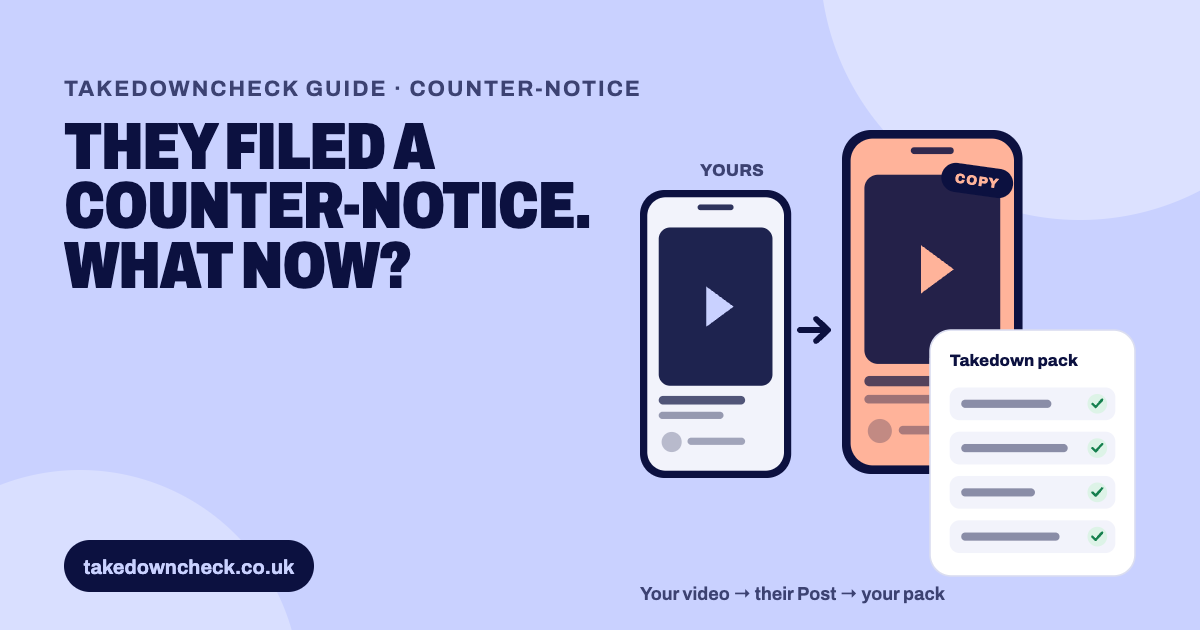
A counter-notice is the uploader's formal claim that their content was removed by mistake or is allowed. It includes their name, address, phone number and a statement under penalty of perjury. The platform sends it to you. On YouTube, you have 10 US business days to provide evidence of legal action, or the video is restored. You can also accept it, or retract your claim if you got it wrong.
When a platform removes content after your copyright report, the uploader can push back. A counter-notice, which YouTube calls a counter notification, is their formal statement that the content was removed by mistake or that they had the right to use it.
The process comes from US law: section 512(g) of the Digital Millennium Copyright Act. The platforms apply the same shape worldwide, including to UK creators and uploaders. It’s a platform process, not a UK legal procedure.
A counter-notice isn’t a verdict. The platform doesn’t decide who owns the work. It sets a clock. If you, the person who reported, don’t show that you’ve taken legal action within that time, the platform can put the content back.
Section 512(g)(3) lists four elements:
YouTube’s version follows the statute closely. The uploader gives their full legal name, address and phone number, explains “why you believe the removal of the content was a mistake or misidentification”, links the removed content, and signs. They swear two statements, including: “I consent to the jurisdiction of the Federal District Court for the district in which my address is located, or if my address is outside of the United States, the judicial district in which YouTube is located, and will accept service of process from the claimant.”
That’s why a counter-notice is serious for the person who sends it. They give their real identity, swear to it under penalty of perjury, and agree to be sued.
You have three realistic choices.
What you shouldn’t do is contact the uploader informally, argue in the comments, or post their details. The personal information in a counter-notice is there for a possible legal claim, nothing else.
| Platform | What the platform says | Time stated |
|---|---|---|
| YouTube | “The claimant has 10 US business days, as required by copyright law, to respond to the counter notification.” | 10 US business days |
| TikTok | Content may be reinstated if TikTok doesn’t receive notice that the claimant “has filed an action seeking a court order to keep the content down”. | No fixed period published |
| Facebook and Instagram | The uploader receives appeal instructions in the removal message. | No fixed period published |
| US law (s.512(g)) | The platform restores the material “not less than 10, nor more than 14, business days” after receiving the counter-notice, unless it receives notice of a court action. | 10 to 14 business days |
Act the day a counter-notice arrives. The clock runs from the counter notification itself, and it counts US business days, not UK working days. US public holidays don’t line up with UK bank holidays.
In YouTube Studio they open the removed video’s copyright details, choose “Submit a counter notification”, give their contact details and rationale, agree to the statements and sign. They can also send it by email to copyright@youtube.com.
“If your counter notification is missing any required information, it may be rejected.”
You receive the uploader’s details and statement. One counter-notice can cover several videos that share the same copyright strike.
YouTube says the claimant “must respond with evidence of legal action taken to keep your content from being reinstated to YouTube.”
“If the claimant doesn’t do this within this 10-day time period, your content will be reinstated to YouTube (unless you have deleted it).”
They can cancel their counter-notice “as long as the claimant hasn’t responded” yet, by replying to YouTube’s confirmation email.
A counter-notice can also be filed after a channel has been terminated. YouTube answers “Yes” to that question on its help page.
On TikTok, the uploader appeals through the in-app removal notification. TikTok’s counter-notification form is only reachable in the app. TikTok requires “your contact information and any evidence to support your claim”, otherwise “your appeal may be denied”.
For uploaders outside the EU, which includes the UK, TikTok says it may “forward your entire appeal to the original reporter, including any contact information you provide”. TikTok adds: “The copyright claimant may use this information to file a lawsuit against you.” It may reinstate the content if it receives no notice of a court action, and “The decision to reinstate any content is at TikTok’s sole discretion.”
TikTok also lists appeal reasons it “generally” won’t accept without valid supporting evidence:
TikTok also says it may remove a strike from the uploader’s account if their appeal is approved, or if you retract your report.
Meta tells uploaders whose content was removed: “You’ll receive instructions about how to appeal in the message that we send you.” Meta refers to the counter-notification concept but doesn’t publish the mechanics, so follow whatever Meta sends you. Meta says that when content is restored after an appeal, or because the rights owner withdrew the report, it takes that into account under its repeat infringer policy.
If the counter-notice shows your report was wrong, retract it. Perhaps the clip was licensed, the uploader made the footage, or the video genuinely reviews your work. On YouTube, retracting will “Clear the copyright strike from the uploader’s channel, unless other video(s) are associated with the strike” and “Restore the uploader’s content to YouTube, unless the uploader deleted the content.”
You can retract in YouTube Studio: Copyright, then the Removal requests tab, then “Retract removal”. Or email copyright@youtube.com. YouTube’s rules for an email retraction are strict:
An example retraction statement to adapt:
I hereby retract my claim of copyright infringement against the video at [link]. [Your full legal name]
YouTube itself gives “I hereby retract my claim of copyright infringement” as its example wording.
The DMCA has a remedy for lies on both sides. Section 512(f) makes anyone who “knowingly materially misrepresents” that material was infringing, or “was removed or disabled by mistake or misidentification”, liable for damages, costs and legal fees. The test is knowing, material misrepresentation. A genuine disagreement or an honest mistake doesn’t meet it.
That cuts both ways, so check your own report first. Confirm it claimed only your work: no title, no licensed music, no archive footage you don’t own. If your report included something that wasn’t yours, the counter-notice may have a point on that part.
This is general information, not legal advice.
For most single re-uploads, going to court to beat a counter-notice isn’t worth it. If a counter-notice is plainly false and the copier is doing real damage, get advice early, because the clock doesn’t stop while you decide.
A counter-notice tests your original report, so the report has to stand up on its own. One Reel reported twice stayed up while every other report came down, which is why we keep each report to one clear work and keep a dated record of every filing. When a counter-notice arrives, that record is what you, and any solicitor, will work from. If you’re getting a report ready, the free pack at the top of this page fills in the form for you to check and submit.
The platforms' own pages this guide is based on.
On YouTube, 10 US business days from the counter notification. US law lets a platform restore content between 10 and 14 business days after receiving one, unless the claimant has filed a court action. TikTok and Meta don't publish a fixed period.
No. If you do nothing, the content will usually be restored and that's the end of it. Keeping it down requires evidence of legal action. That's a decision to make with a solicitor, not in a hurry.
It comes from US law, section 512 of the DMCA, but the platforms apply it to UK creators as a matter of their own process. YouTube's counter notification handles addresses outside the US by naming the district where YouTube is located.
Under US law, a person who 'knowingly materially misrepresents' that material was removed by mistake can be liable for damages. An honest mistake isn't enough. Whether a UK court would apply that section is a question for a solicitor.
Retract it. On YouTube, a retraction clears the strike and restores the content. It must come from the original claimant, from the same email address or domain, and retract the removal request itself.
Use them only for the dispute. Don't post them, share them or contact the uploader informally. The details are there so a legal claim can be served if you decide to bring one.