Facebook, Instagram, TikTok and YouTube
Every box of the real report form, in order, filled in and counted to the platform's limits.

Meta copyright form7 boxes filled
Why a copyright report to Meta can fail, why there's no appeal for the person who reported, and how to file a stronger report or take it further.
Every box of the real report form, in order, filled in and counted to the platform's limits.
Check your email. We've sent a link to start your pack to
Name the accounts copying you. When they post your work again, a new pack is waiting in the morning.
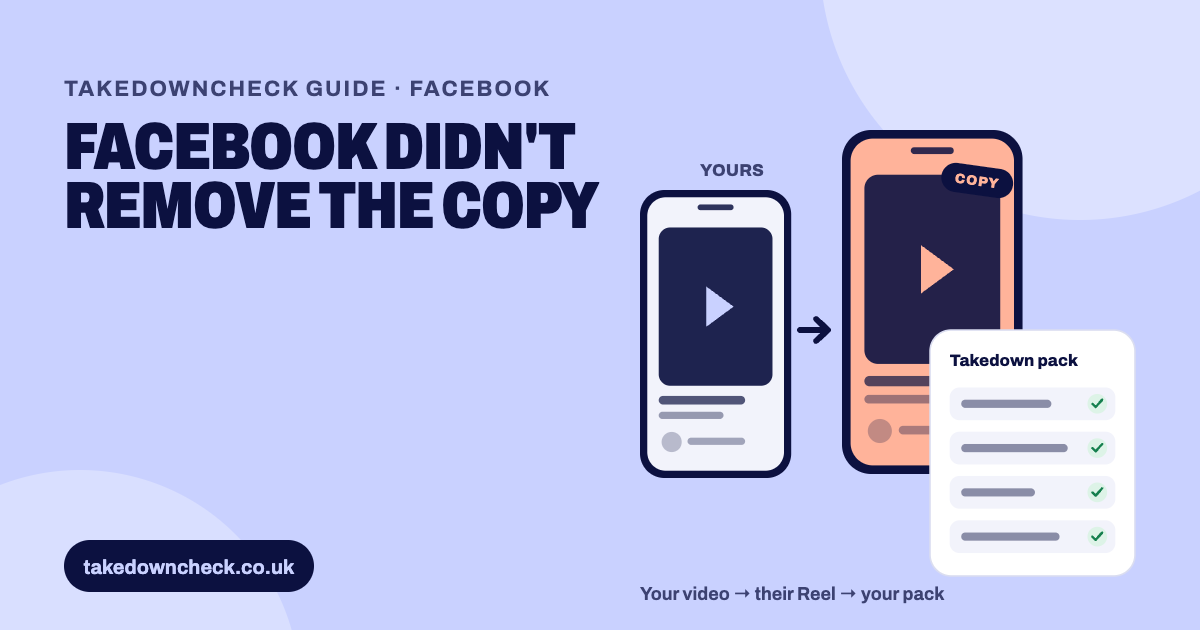
Meta gives reporters no appeal when it declines a copyright report. Only the uploader gets one. So work out why it failed, then file a new, tighter report: one work, direct links to each copy, a link to your original and a precise description of what you made. Meta's designated agent is a formal alternative, not a faster route. If the copying costs you money, UK courts are the last step.
Start by working out what actually happened. “Still up” can mean three different things, and each needs a different fix.
Also check the copy yourself. Open the link in a private browser window. A post the uploader deleted, or one that now shows “content isn’t available”, has already gone. Take a dated screenshot either way.
No, not as the person who reported it. Meta’s copyright policy describes an appeal route for the uploader whose content was removed. It tells them: “You’ll receive instructions about how to appeal in the message that we send you.” There’s no equivalent for a rights owner whose report is declined or ignored. Meta also offers no tool to check a report’s status.
That sounds bleak, but it’s useful to know. It means your next step is a better report, not a wait for a review that won’t come. Meta’s own numbers show most copyright reports work: its transparency report records that 83.19% of content reported for copyright in December 2023 was removed. That’s the latest month Meta has published, so it’s a dated figure. Read the other way, about one in six pieces of reported content stayed up.
Meta doesn’t publish a list of rejection reasons. It does publish what it requires, and the gaps usually fall in the same places.
Before you file again, gather:
If you’d like the refiled report drafted for you, the free pack at the top of this page fills in every box of the form, ready for you to paste and submit.
Use Meta’s intellectual property form. There isn’t a separate appeal form, so a new report is the route.
Select Copyright under “What right is being violated or infringed?”, then Facebook or Instagram.
Under “Where are you asserting rights?” pick your country. Answer “Are you the rights owner?” truthfully. An agent uses “No, but I’m authorised to represent the rights owner”.
Paste the direct link to each copy of this one work, and link your original. Leave out any post that doesn’t use your work.
Name the parts that are yours: the footage you shot, your narration, your edit, your thumbnail design. Say what the copy took.
Give your earlier report numbers and dates. Read the declaration before you confirm it, then save the new report number.
The difference between a report that fails and one that works is often a single clear paragraph. This is an example to adapt:
I made this video and first published it on my YouTube channel on [date]: [link to your original]. The Reel at [link] re-uploads [length] of it, including my footage and my narration, with new captions added. It adds no commentary on my work. I reported this Reel on [date] (report number [number]) and it is still live. I have not given this account permission to use my work.
Only describe what you own. If your video uses licensed music or someone else’s clip, don’t claim those parts.
Meta publishes no review time, so don’t count days against a promised deadline. Expect a new automated message with a new report number. Meta may write asking for more information. Answer quickly and precisely.
If Meta removes the copy, it will regularly tell the uploader the report number, the rights owner’s name, your email address, the report details and how to appeal. If the uploader’s appeal succeeds, the post can come back. Meta says a restoration after an appeal, or after a rights owner withdraws a report, is taken into account under its repeat infringer policy.
Meta’s copyright policy lists a formal postal route: Meta Platforms, Inc., FAO: Meta Designated Agent, 1601 Willow Road, Menlo Park, California 94025, US, phone +1 650 543 4800. Meta says a notice sent this way must include “a complete copyright claim”, but it doesn’t define what “complete” means. Include everything from your online report, plus every report number and date.
Be realistic about it. Meta calls its online form “the fastest and easiest way” to report, so the designated agent is a parallel legal channel, not a faster lane. Meta also publishes different email addresses for different products. Don’t send your notice to one you’ve seen quoted on a blog.
Copy accounts often point viewers to a website with the same story and your thumbnail. That website has its own host, domain registrar and search listing, each with its own reporting route. Our guide to a website copying your video covers them.
If one account keeps taking your catalogue, Meta’s matching tool may be worth applying for. For creators, Meta says Rights Manager in Meta Business Suite “is going away soon” and enrolled creators will use “the content protection tool, located in Professional dashboard on Facebook”. You need a catalogue of wholly original content and a clean record, and rejected applicants wait 7, 21 or 60 days to reapply. Meta says people without access “may report individual infringements through our IP reporting forms”.
This is general information, not legal advice.
One Reel reported twice stayed up while every other report in the same case came down. The reports that worked each named one work clearly, and we had a dated record of every filing to fall back on. When a report fails, rewrite it tighter rather than sending the same words again.
The platforms' own pages this guide is based on.
Not formally. Meta's copyright policy describes an appeal route only for the person whose content was removed. A reporter whose report is declined can file a new, clearer report, but there's no documented way to ask Meta to reconsider.
Meta doesn't offer a status tracker. Your record is the automated message with your report number and any later email from Meta, so keep them together with the date you filed.
Meta's copyright policy gives its designated agent's postal address and phone number. It publishes different email addresses for different products, so don't rely on one you've seen quoted elsewhere. Meta calls its online form the fastest and easiest way to report.
Meta's transparency report shows 83.19% of content reported for copyright was removed in December 2023. That's the most recent month Meta has published, so it's a dated figure.
Not as a UK creator. Since 25 April 2023 UK users have been served by Meta Platforms, Inc., the US company, and the Digital Services Act is EU law.
Meta doesn't say repeat reports count against a genuine rights owner. What matters is that each report is accurate. Never report something you don't own just to add pressure.